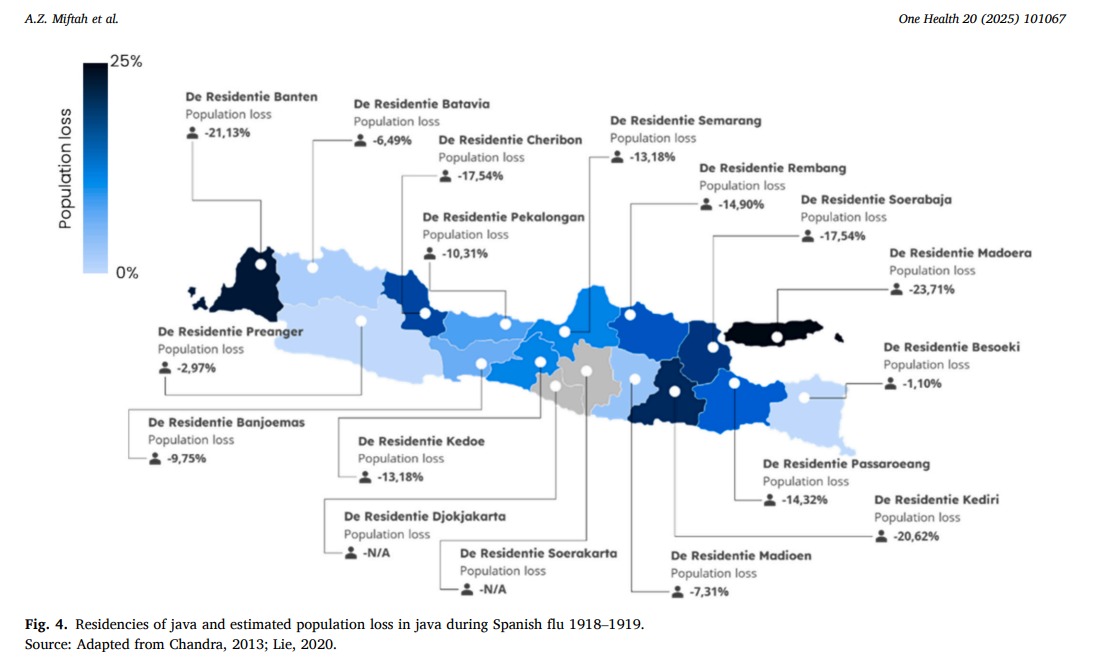
Bandung – A research team from Universitas Padjadjaran conducted a historical study on the Indonesian government’s response to health crises, ranging from the Spanish Flu pandemic in 1918 to the COVID-19 pandemic. The findings were published in the international journal One Health under the title “Historical review of the Indonesian government’s response to health crisis: From the Spanish flu to the COVID-19 pandemic”.
The study, led by Ahmad Zaini Miftah, Ida Widianingsih, Connie Hoe, and Irvan Afriandi, employed a retrospective policy analysis approach to trace various responses and policies issued by the government, from the Dutch East Indies era to the reform era.
Research Findings
The study revealed that pandemics and infectious disease outbreaks in Indonesia—such as cholera, plague, the Spanish Flu, and COVID-19—have consistently placed immense pressure on the health, economic, and social systems. In both colonial and modern Indonesia, government responses were often perceived as slow and lacked optimal cross-sectoral integration.
The One Health concept, which integrates human, animal, and environmental health, was found to be crucial in strengthening the national health system. The study emphasized that reforming Indonesia’s health system must proportionally incorporate these three aspects. Challenges such as cross-sectoral coordination, policy segmentation, and limited funding remain key obstacles.
Recommendations
The researchers recommend that reform of the national health system should not only focus on treatment and containment but also prioritize prevention of infectious diseases through a One Health approach. The government is urged to enhance inter-ministerial coordination, improve public health literacy, and establish a fair financing framework across human, animal, and environmental health sectors.
“Through the One Health approach, lessons from Indonesia’s historical experiences with outbreaks can serve as valuable reflections to develop more responsive and sustainable health policies in the future,” the research team stated.
Academic Contribution
This study provides not only a historical overview but also an academic contribution to enrich health policy literature in Indonesia. The findings are expected to serve as valuable input for the government in strengthening a more adaptive and resilient national health system to face future infectious disease threats. (SDGs 3)
Author: Ahmad Zaini Miftah
Source: https://www.scopus.com/pages/publications/105005645194